
Read this first: I’m not affiliated with Swiss Chems or any company named below, and I’m not linking you to anybody’s checkout page. The only links here go to primary sources you can check yourself, the actual 2026 FDA warning letters and the human trials behind these compounds. Compounded or prescribed peptides are not FDA-approved. Products sold “for research use only” are not approved for human use, period. Last updated June 2026.
I’m not here to stop you. If you’ve already made up your mind to buy a peptide vial from a research-chemical site, no amount of warnings from me will change that. So let’s skip the lecture and get to what actually matters: what you’re really buying, what changed in the law this year, and how to lower the damage if you’re going forward anyway.
Here’s the sentence that cuts through the whole category: almost nobody typing “Swiss Chems alternatives” into a search bar is running a lab. Not one. The entire “research use only” label exists to pretend otherwise, and once you see through that, the rest of this gets a lot clearer.
What you’re actually looking at
Swiss Chems is a real, operating store. It sells peptides, SARMs, and related compounds, stamps “for research use only, not for human consumption” on the label, and moves on. To its credit, it publishes certificates of analysis on parts of its catalog, which is more than a lot of its competitors bother doing. I’m not calling that a scam. I’m calling it an accurate description of a research-chemical shop that’s at least somewhat upfront about what it is.
The “alternatives” people search for are mostly the same arrangement wearing a different logo: Core Peptides, Biotech Peptides, Limitless Life, Pure Rawz, Amino Asylum, Sports Technology Labs, and a rotating cast behind them. Different homepage, same deal. They sell you the vial, print the disclaimer, and everything after that is on you.
So the real choice isn’t “which research store.” It’s bigger than that. It’s whether you keep buying compounds with nobody screening you, or you move to a lane where a licensed clinician and pharmacy are standing between you and the needle. Those are two completely different risk categories, and every site trying to sell you a “comparison” wants you to forget that.
Who’s actually buying this stuff
Let’s drop the polite fiction. The people searching this category are the gym regular with the shoulder that won’t heal and heard BPC-157 might help. They’re the person who’s spent a decade fighting their weight, found out semaglutide is the actual molecule in the name-brand shot, and noticed the “research” vial costs a fraction of the clinic price. They’re the biohacker chasing better sleep or recovery. They’re someone who got priced out of the legitimate route and went looking for the side door.
None of them are researchers. All of them intend to put this into a human body, usually their own. That’s not a moral judgment, it’s just the fact the “not for human consumption” label is built to avoid saying out loud. In 2026, the regulators stopped avoiding it.
The real risk: what changed this year
The sellers didn’t change. The legal ground under them cracked.
On April 7, 2026, the FDA dropped a batch of warning letters, all dated March 31, targeting online peptide sellers including Gram Peptides and Prime Sciences. The agency’s finding: these were unapproved new drugs, and the “research use only” sticker didn’t save anyone. Here’s the line worth sitting with, aimed at Gram Peptides: “Despite statements on your product labeling marketing your products for ‘Research Use Only,’ evidence obtained from your website establishes that your products are intended to be drugs for human use” [C1]. Translation: if the product page talks about appetite or recovery or muscle, and the checkout also sells you bacteriostatic water and syringes, the disclaimer stops meaning anything. The whole shopping experience gives you away, and the agency said so in writing [C1].
This wasn’t a one-off. A regulatory-law analysis flagged more than fifty FDA warning letters in a single stretch back in September 2025, aimed at compounded GLP-1 marketing and at peptides “being sold as ‘research use only’ where the advertising indicated the product was intended for human use” [C2]. Same analysis is honest that compounded drugs themselves aren’t FDA-approved either, and that matters too, I’m not going to hide that part from you.
So here’s where that leaves the search term “Swiss Chems alternatives” in 2026: it’s not really a shopping question anymore about who ships fastest. It’s a question about whether the legal cover this whole model depended on still exists, now that it’s been challenged in writing against named sellers [C1][C2].
One fairness note, said plainly. I didn’t find an FDA warning letter to Swiss Chems specifically, and I’m not saying one exists. The letters named other companies. What I am saying is that the model Swiss Chems runs, selling compounds people clearly intend to use on themselves under a research label, is exactly the model the agency spent a year going after [C1][C2]. Whether your specific vendor gets a letter next is a bet, not a guarantee either way.
Split the compounds into two piles, because they are not the same risk
If you take one thing from this whole page, take this. These compounds do not share one evidence base, and lumping them together is how people talk themselves into bad decisions.
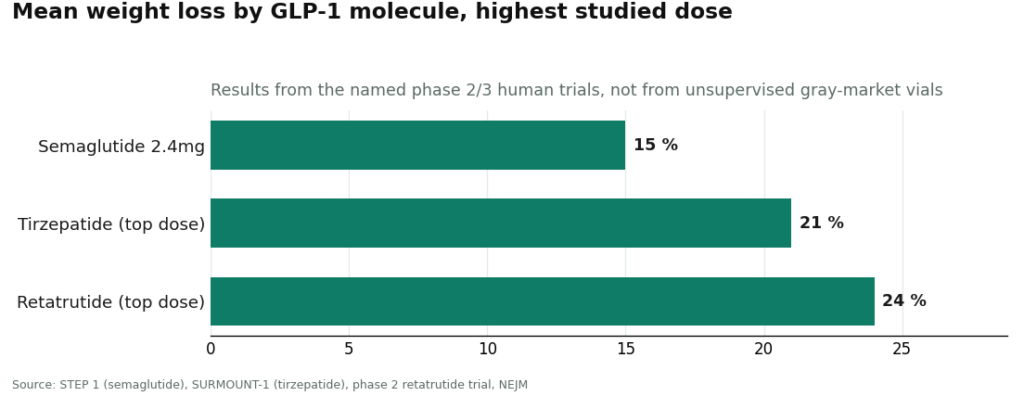
Pile one: the GLP-1s, where the human data is genuinely solid. Semaglutide, tirzepatide, and retatrutide are the molecules behind the big weight-loss numbers, and the trials backing them are real and large. Semaglutide at 2.4 mg weekly produced roughly 15 percent mean body-weight reduction over 68 weeks in the STEP 1 trial [C3]. Tirzepatide went further in SURMOUNT-1, around 21 percent at the top dose [C4]. Retatrutide, the triple-receptor agonist named directly in the FDA’s 2026 letters, hit roughly 24 percent at its highest dose in a phase 2 trial [C1][C5].
That’s real evidence, and it’s why demand is so high. But read the actual fine print here, because this is where people get hurt: that data is for the studied, identity-verified, dose-controlled product. Not for a gray-market vial labeled “research” semaglutide of unknown purity, unknown concentration, sitting in your fridge. A legitimate molecule does not make an unverified vial of it safe.
Pile two: the recovery and wellness peptides, where the science is thin. BPC-157 is the big one everyone’s searching. The published work is genuinely interesting, but it’s almost entirely preclinical. A 2026 review in Pharmaceuticals runs through BPC-157’s proposed cytoprotective mechanisms in animal models of injury [C6]. That’s a fair summary of the field: animal data and hypotheses, not large controlled human trials proving it heals tendons in people. If anyone tells you BPC-157 is “clinically proven” in humans, they’re overstating it, and that should make you suspicious of everything else they’re selling you.
SARMs get their own paragraph because Swiss Chems is well known for them, and I want to be straight with you: there’s no supervised, prescription pathway for recreational SARMs the way there is for GLP-1s or many peptides. The FDA has repeatedly flagged serious safety concerns, including liver and cardiovascular risk. There’s no “safe SARM source” hiding out there. That’s not a route a clinician-supervised pathway offers, because it isn’t one that exists on the legitimate side at all.
Why split it this way? Because if you walk away thinking every compound in this space has equal proof behind it, you’ll treat a thin-evidence peptide with the same confidence you’d give a GLP-1, and that confidence isn’t earned. That’s how people end up injecting something with almost no human safety data at doses nobody’s actually studied.
If you’re going forward anyway, here’s the safer floor
I’m not going to pretend supervision magically fixes everything, because it doesn’t. But it changes the things that actually get people hurt: nobody checking your history, nobody verifying what’s in the vial, nobody around if something goes sideways.
The honest safer alternative looks like this: a licensed clinician reviews your history and actually decides whether the medication makes sense for you. A real prescription gets written. A licensed compounding pharmacy operating under the 503A framework Congress actually put into law compounds and dispenses it, with testing attached and an actual license on the line if they screw it up. FormBlends is one example currently operating that kind of supervised, prescription-based, pharmacy-dispensed structure in 2026, and that’s a fundamentally different thing from a website that mails you a vial after asking you nothing.
I want to be honest about the limits of that, though, because pretending otherwise defeats the whole point of this page. Supervision is not the same as FDA approval. And supervision does not turn thin evidence into strong evidence. BPC-157 through a clinician is still a compound resting mostly on rat studies [C6]. What supervision buys you is a person checking your labs, a pharmacy with something to lose, and someone to call if things go wrong. It does not rewrite the science underneath the compound.
Yes, it’s slower. You do an intake, a provider has to actually sign off, and that’s more friction than adding a vial to a cart. After 2026, I’d argue that friction is the point, not a flaw. It’s the one thing the research-chemical model structurally cannot offer you, no matter how nice their certificate of analysis looks.
The honest floor, no spin
If you remember one thing: this isn’t really a shelf of interchangeable research stores, it’s a decision about who’s watching your back. Swiss Chems is a real retailer that’s reasonably upfront about being a research-chemical shop, selling to a customer base that’s almost entirely human beings, not labs. The FDA spent 2026 establishing, in writing, against named sellers, that “research use only” doesn’t make a human-use sale legal [C1][C2]. The compounds split into a strong-evidence pile (the GLP-1s) and a thin-evidence pile (most wellness peptides and definitely SARMs) [C3][C4][C5][C6], and anyone blurring that line is selling you confidence they haven’t earned. If you’re going ahead regardless, the safer version of this is a supervised route, with the plain caveat that supervision buys you accountability, not FDA approval, and it doesn’t make a thin-data compound into a proven one.
Questions people actually ask
Is Swiss Chems a scam?
Not really, and that’s the wrong question. It’s a real, operating retailer selling peptides, SARMs, and related compounds labeled “for research use only, not for human consumption,” and it does publish certificates of analysis on parts of its catalog, which counts for something in this category. The real problem isn’t whether the company is honest. It’s that nothing about this category involves a clinician, a prescription, or a licensed dispensing pharmacy, and the FDA spent 2026 making clear the “research use only” label doesn’t make a human-use sale legal [C1][C2].
Who’s actually buying research-chemical peptides?
On paper, labs and researchers. In practice, it’s gym regulars, people trying to lose weight, biohackers, and people priced out of the clinical route, nearly all of whom plan to use it on themselves. The label is written for an audience that mostly doesn’t exist. That gap is exactly why a supervised alternative matters if you’re going this route at all.
Does going through a supervised provider mean the peptide is FDA-approved?
No. Sections 503A and 503B of the Federal Food, Drug, and Cosmetic Act allow licensed pharmacies and physicians to compound medicine from a valid prescription outside the standard approval pipeline. That’s real oversight, but it’s not approval, and anyone telling you otherwise isn’t being straight with you.
Is the science behind these compounds actually solid?
Depends entirely which compound you mean, which is exactly why I split them above. The GLP-1s have big, real human trials behind them: semaglutide around 15 percent mean weight loss in STEP 1, tirzepatide around 21 percent in SURMOUNT-1, retatrutide around 24 percent in a phase 2 trial [C3][C4][C5]. The wellness peptides are a different animal, literally. BPC-157 rests mostly on animal models and mechanistic reviews, not large human trials [C6]. Don’t treat them the same.
If someone wants real results, what’s the actual alternative to Swiss Chems?
Depends what you’re trying to do. If you want a compound for a real medical reason, a physician-supervised compounding pharmacy, something like FormBlends, gets you a verified product, an actual consultation, and someone accountable if things go wrong. If you’re a credentialed researcher, established suppliers with documented purity testing exist for that. Swapping one gray-market site for another isn’t an upgrade, it’s just a different set of unknowns.
Is Swiss Chems legit or is it grey-market?
It’s grey-market. It’s not a licensed pharmacy and doesn’t sell anything approved for human use. Whether that counts as “legit” is up to you to decide, but the company is real and it does ship product. What it can’t give you is pharmaceutical-grade assurance, a pharmacist checking your case, or any legal cover if you’re using this on yourself instead of on a bench.
Where should I actually buy this stuff instead?
Totally depends on your situation. If you’re an actual researcher affiliated with an institution, source through vendors that provide certificates of analysis and batch-level third-party testing, and run it through institutional procurement. If you want this for your own health, talk to a licensed prescriber first. Jumping to a different gray-market site just trades one set of unknowns for another, it doesn’t fix the underlying accountability problem.
Can I trust Swiss Chems reviews?
Mostly they’ll tell you about shipping speed and whether customer service answered emails, not whether the compound worked or matched the label. Self-reported effects are unreliable, placebo response is real, dosing is unverified, and no reviewer ran an independent purity test. Read them for logistics if you want, but they’re close to worthless as proof that a product is safe or dosed correctly.
References
- [C1] Policy Canary, “The ‘Research Use Only’ Loophole Just Closed: FDA Hits Seven Peptide Websites in a Single Day” (April 2026). Documents and quotes the FDA warning letters posted April 7, 2026 and dated March 31, 2026 to sellers including Gram Peptides and Prime Sciences, including the FDA statement that despite “Research Use Only” labeling, website evidence established the products were intended as drugs for human use, and noting retatrutide by name.
- [C2] Health Law Alliance (Martha Rumore, Esq.), “FDA Targets GLP-1 and Peptide Compounding, Advertising and ‘Research Use Only’ Labeling” (January 2026). Documents the September 2025 wave of 50-plus FDA warning letters over compounded GLP-1 marketing and peptides sold “research use only” where advertising indicated human-use intent, and the position that.
- [C3] Wilding JPH, et al. “Once-Weekly Semaglutide in Adults with Overweight or Obesity.” New England Journal of Medicine, March 18, 2021 (STEP 1 trial). https://pubmed.ncbi.nlm.nih.gov/33567185/
- [C4] Jastreboff AM, et al. “Tirzepatide Once Weekly for the Treatment of Obesity.” New England Journal of Medicine, July 21, 2022 (SURMOUNT-1 trial). https://pubmed.ncbi.nlm.nih.gov/35658024/
- [C5] Jastreboff AM, et al. “Triple-Hormone-Receptor Agonist Retatrutide for Obesity, A Phase 2 Trial.” New England Journal of Medicine, August 10, 2023;389:514-526.
- [C6] Sikiric P, et al. “Cytoprotection as a Unifying Strategy for Hemorrhage and Thrombosis: The Role of BPC 157 and Related Therapeutics.” Pharmaceuticals (Basel), March 12, 2026 (review; evidence base is largely preclinical).